
Gifted, Paid Partnership, or Affiliate: What Is the Difference and Why It Matters Legally

Published by LegalLens | legallens.co.uk
You received a package in the post. A brand slid into your DMs with a discount code. A company offered you a free trip in exchange for coverage. Another one wants to pay you a flat fee for three posts.
These are four completely different legal arrangements - and treating them the same way could land you in serious trouble with the ASA, the CMA, and HMRC.
The words "gifted," "paid partnership," and "affiliate" are thrown around casually in the creator economy as if they are interchangeable. They are not. Each one carries distinct legal obligations around disclosure, tax, and your rights as a creator. Getting this wrong is not just embarrassing - under the DMCC Act 2024, it can result in fines of up to 10% of global turnover for the brands involved, and personal enforcement action against you as a creator.
This guide breaks down exactly what each arrangement means, what you are legally required to do in each case, and where creators most commonly go wrong.
Why This Distinction Matters More Than Ever
Before we get into the definitions, it is worth understanding why regulators care so much about this.
The core principle behind UK and EU advertising law is simple: consumers have the right to know when they are being marketed to. When a creator posts about a product without making the commercial relationship clear, consumers are misled into thinking they are getting an honest, unpaid recommendation. That is the exact problem the ASA, the CMA, and the FTC were set up to prevent.
The law does not care what you call the arrangement. It cares about the substance of it. The question regulators ask is not "was this a gifted post or a paid post?" - it is "did this creator receive any benefit, direct or indirect, in connection with promoting this product?" If the answer is yes, disclosure is required.
The label you use in your caption is a separate question. And that is where it gets complicated.
What Is a Gifted Collaboration?
A gifted collaboration - sometimes called a "product gifting" arrangement - is one where a brand sends you a product, experience, or service for free, without paying you a fee, in the hope that you will post about it.
The Legal Reality
Under UK law, gifted products count as a commercial arrangement the moment there is any expectation of coverage - even an implied one. The CMA's 2023 guidance makes this explicit: if a brand sends you something with the expectation that you will post about it, that is advertising, and it must be disclosed clearly.
It does not matter that no money changed hands. The product itself is a form of payment. A £300 skincare set, a free hotel stay, or a gifted gym membership all have real commercial value, and the brand is receiving promotional benefit in return.
The ASA's position is equally clear: content created in exchange for gifted products must be labelled as an ad. Using vague terms like "#gifted," "#spon," or "#collab" is not sufficient. The disclosure must be unambiguous, prominent, and placed where consumers will see it before engaging with the content.
What Disclosure Is Required
For gifted content in the UK, the required label is #Ad or the phrase "Advertisement", placed at the very beginning of the caption or overlaid prominently on the video, before any "read more" cut-off.
The commonly used hashtag #gifted does not meet the legal standard on its own. Research commissioned by the CMA found that a significant proportion of consumers do not understand "#gifted" to mean that the creator received the product for free in exchange for coverage. The ASA has upheld complaints against creators who used #gifted without #Ad.
The "Unsolicited Gift" Exception
There is one narrow exception worth knowing. If a brand sends you a product completely unsolicited - no email, no DM, no prior agreement, and no expectation of coverage expressed - and you choose to post about it anyway, that post does not technically require an ad disclosure because there was no commercial arrangement.
However, the moment you have any prior relationship with the brand, received any communication about the product before it arrived, or have a history of posting about their products in exchange for freebies, regulators will treat it as a commercial arrangement regardless of the framing.
In practice, the safest position is to disclose every time a brand is involved, regardless of whether you were paid.
What Is a Paid Partnership?
A paid partnership is what most people mean when they talk about a "brand deal." The brand pays you a flat fee - or a day rate, or a project fee - in exchange for creating and publishing specific content to agreed deliverables.
This is a commercial contract. And it should be treated exactly like one.
The Legal Reality
A paid partnership is the most straightforward arrangement from a disclosure perspective. There is no ambiguity: money changed hands, content was commissioned, disclosure is required. Every platform now has a "paid partnership" label built in, and using it alongside #Ad in the caption is current best practice.
Where creators and managers go wrong is not on disclosure - it is on the contract.
A verbal agreement or a DM exchange is technically enforceable under UK contract law, but it leaves enormous gaps that brands routinely exploit. The most common areas of dispute in paid partnerships are:
Usage rights. The brand pays for three Instagram posts. Six months later they are running your content as a paid Facebook ad, on their website, and on an out-of-home billboard. Without a written contract specifying the permitted channels, territory, and duration of use, you have very limited recourse.
Whitelisting. A brand asks to "boost" your posts. What they are actually requesting is the right to run paid advertising from your creator account, targeting audiences beyond your own followers. This is a distinct service that commands an additional fee - but many creators sign contracts that include it as standard.
Exclusivity. A contract includes a clause preventing you from working with competing brands for 90 days. Without proper compensation for that exclusivity window, you are effectively working for the brand for free during that period.
Approval rights. The brand has unlimited revision requests with no cap. You spend three weeks going back and forth on edits and receive no additional payment.
Every single one of these issues can be resolved with a properly drafted paid partnership agreement. Without one, you are at the brand's mercy.
What a Paid Partnership Contract Must Include
At minimum, every paid partnership agreement should specify:
Exact deliverables - platform, format, quantity, and posting dates
Fee and payment schedule - including what triggers each payment milestone
Usage rights - channels, territory, and duration
Whitelisting - whether it is included and at what additional fee
Exclusivity - the category, duration, and compensation for the restriction
Kill fee - what you are owed if the brand cancels after work has begun
IP ownership - who owns the content and under what conditions
Revision limits - how many rounds of amends are included
If the contract you have been sent does not cover all of these, it needs to be renegotiated before you sign.
What Is an Affiliate Arrangement?
An affiliate arrangement is one where you earn a commission on sales generated through a unique link or discount code. Instead of a flat fee, your income is tied to performance - typically a percentage of each sale made through your tracking link.
Affiliate marketing is one of the fastest-growing income streams in the creator economy, and it is also one of the most legally misunderstood.
The Legal Reality
Many creators believe that affiliate links do not require disclosure because they did not receive a direct payment from the brand. This is incorrect.
The commission you earn on each sale is a form of remuneration. The CMA and ASA are unambiguous: affiliate content must be disclosed as advertising in exactly the same way as a paid partnership. The fact that the payment is performance-based rather than upfront does not change the nature of the commercial relationship.
The FTC in the United States is equally strict. Its 2023 updated guidance specifically addresses affiliate marketing, requiring clear and conspicuous disclosure that the creator earns a commission if consumers purchase through their link.
The disclosure must appear in every post, Story, video, or caption where the affiliate link or code is used. A single disclosure in your bio or a pinned highlight is not sufficient.
The Tax Position
This is where affiliate arrangements diverge most significantly from gifted or paid partnerships, and where creators most frequently find themselves in difficulty.
Affiliate income is taxable. It must be declared to HMRC as income from self-employment, regardless of whether you receive it through a formal invoice or via an automatic payout from an affiliate platform. Many creators who started with affiliate marketing assume that because the income is passive and comes in small amounts from multiple sources, it does not need to be declared. It does.
If you are earning affiliate income alongside a salary, you will likely need to file a Self Assessment tax return. If your total income from affiliate marketing exceeds the trading allowance (currently £1,000 per tax year), you are required to register as self-employed with HMRC.
Affiliate Contracts and Your Rights
Affiliate arrangements are often governed by the platform's standard terms rather than a bespoke agreement. This matters because:
The brand or platform can change the commission rate or terminate your affiliate access at any time
You may have no guaranteed income floor
Your content may be subject to the brand's usage rights under their standard terms, which you agreed to when you signed up
Before building a significant portion of your income around affiliate marketing, it is worth having the platform terms reviewed to understand exactly what you have agreed to and what protections - if any - exist.
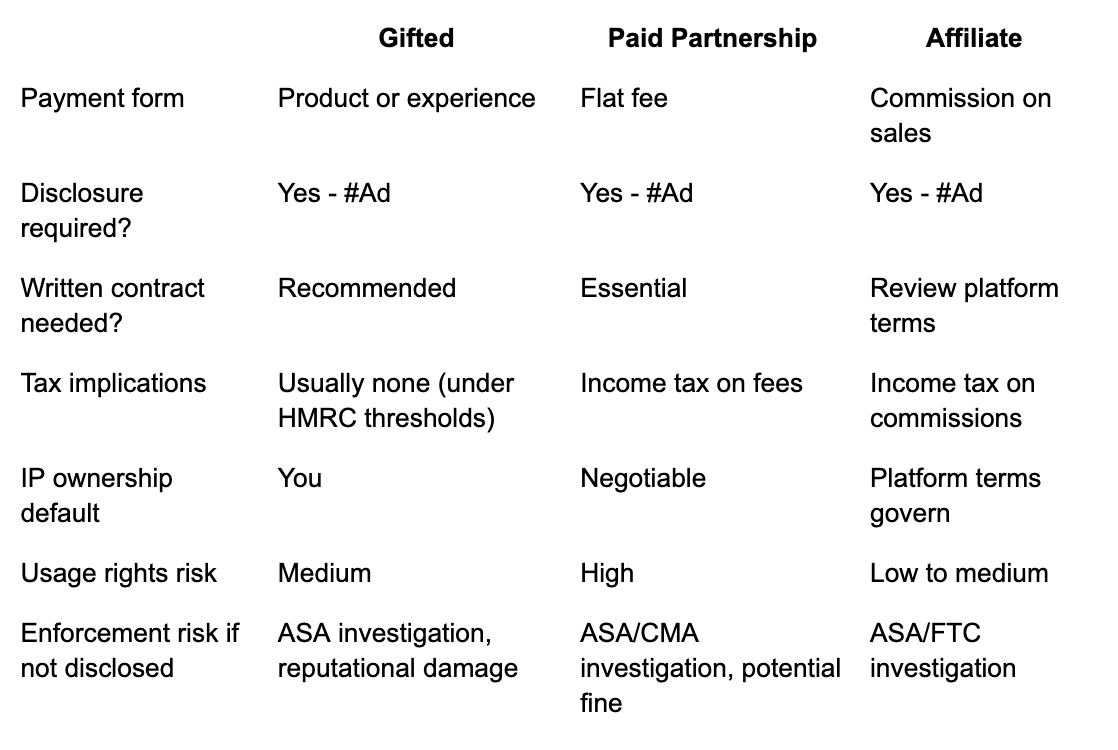
Side-by-Side Comparison: What Each Arrangement Means for You
The Most Common Mistakes Creators Make
Mistake 1: Using #gifted instead of #Ad
As discussed above, #gifted does not meet the legal standard for ad disclosure in the UK. Always use #Ad, always place it at the start of the caption, and always ensure it is visible before the "read more" cut-off on any platform.
Mistake 2: Assuming payment determines disclosure
Disclosure is required whenever there is a commercial relationship - not just when money changes hands. A gifted product, a free trip, an affiliate commission, an invitation to an exclusive event: all of these trigger the disclosure requirement.
Mistake 3: Signing a paid partnership contract without reading the usage rights clause
The fee you negotiate covers content creation. The usage rights clause determines what the brand can do with that content and for how long. These are two entirely separate things, and many creators discover too late that they signed away far more than they intended.
Mistake 4: Not tracking affiliate income for tax purposes
Affiliate income is not "pocket money." It is taxable trading income. If you are earning from affiliate links across multiple platforms, keep records of everything and speak to an accountant or legal professional about your obligations.
Mistake 5: Treating a gifted arrangement as if it carries no contractual weight
Even without a formal contract, a gifted arrangement involves obligations on both sides - and potential IP questions if you create content as part of it. Who owns the photos you took for the gifted post? Can the brand repost them? These questions matter even when no money changes hands.
What Happens If You Get This Wrong
The consequences of non-disclosure or misclassification are real and escalating.
The ASA regularly names and shames creators and brands for failing to disclose commercial relationships properly. These rulings are published on the ASA's public website and picked up by marketing press, causing reputational damage that is difficult to recover from.
The CMA has enhanced powers under the DMCC Act 2024 to take direct enforcement action - including fines - against both influencers and brands involved in non-compliant campaigns. The CMA has explicitly stated that it will target creators with large followings who repeatedly fail to disclose.
For brands, the stakes are even higher. Fines under the DMCC Act can reach 10% of global annual turnover. A brand that engaged you as a creator and failed to ensure your posts were properly disclosed can face enforcement action too - which means they will increasingly require contractual disclosure guarantees from the creators they work with.
How LegalLens Can Help
Whether you are navigating your first gifted collaboration, renegotiating a paid partnership contract, or trying to understand what you have signed up to as an affiliate, getting the legal framework right from the start protects your income, your reputation, and your creative output.
At LegalLens, we work exclusively in entertainment and media law. We help creators and talent managers:
Review and negotiate paid partnership contracts - flagging rights-grab clauses, inadequate kill fees, and unlimited revision terms before you sign
Advise on disclosure obligations - ensuring your content meets ASA, CMA, and FTC requirements for every type of commercial arrangement
Draft bespoke influencer agreements - covering gifted, paid, and affiliate arrangements with full legal protection built in
Audit existing arrangements - identifying compliance gaps in your current brand partnerships before regulators do
Our fees are flat-rate and transparent, capped at 10% of the contract value. No hourly rates. No unexpected bills.
Frequently Asked Questions
Do I have to disclose a gifted product if the brand did not ask me to post about it?
If there was any expectation of coverage - even an implied one based on your prior relationship with the brand - yes, disclosure is required. The only exception is content you create entirely spontaneously about a product you received with no prior contact or commercial understanding. In practice, this is rare.
Is #gifted enough for a gifted post?
No. UK regulators including the ASA and CMA have confirmed that #gifted alone is insufficient. You must use #Ad or "Advertisement" placed prominently at the start of the caption.
What is the difference between whitelisting and a paid partnership?
A paid partnership involves creating and posting content to your own channel. Whitelisting means giving the brand permission to run paid advertising from your creator account - targeting audiences beyond your own followers. Whitelisting is a separate service and should be priced and contracted separately.
Do I need to disclose affiliate links on every post?
Yes. The disclosure must appear in every individual piece of content where the affiliate link or code is used. A single disclosure in your bio does not cover individual posts, Stories, or videos.
Can a brand make me post about a gifted product?
No. If you have not signed a contract requiring you to post, you are under no legal obligation to create content about a gifted product. However, if a contract is in place - even an informal one via email or DM - you may have obligations. Always clarify the terms before accepting gifted products.
Is affiliate income taxable in the UK?
Yes. Affiliate commissions are taxable as self-employment income. If your total income from affiliate marketing exceeds the trading allowance of £1,000 per tax year, you must register as self-employed with HMRC and declare this income in a Self Assessment tax return.
What should I do if a brand pressures me to post without disclosing?
Do not comply. Asking a creator to post undisclosed advertising is itself a breach of the CAP Code and potentially the DMCC Act. If a brand is pressuring you to hide the commercial nature of a post, that is a significant red flag about how they operate - and you should seek legal advice before proceeding.
The Bottom Line
Gifted, paid partnership, and affiliate are not just different words for the same thing. They are distinct legal arrangements with different disclosure requirements, different contractual implications, and different tax consequences.
The creator economy is no longer a regulatory grey area. The ASA, the CMA, and HMRC all have you in their sights - and so do the brands who want to use your content without paying fairly for it.
Understanding the difference between these arrangements is the foundation of running your creative work as the legitimate business it is.
If you are not sure which category your current brand deals fall into - or whether your contracts are protecting you properly - LegalLens is here to help.
Contact us at contact@legallens.co.uk
Fixed fees are capped at a maximum of10% of contract value
Free 15‑minute consultation for new clients
This article does not constitute legal advice and is provided for general information purposes only. Always consult a qualified legal professional for advice tailored to your specific situation.