
The Exclusivity Clause Playbook: How to Price It Fairly and Stop Brands Locking You Into Broad Category Traps

Published by LegalLens | legallens.co.uk
An exclusivity clause is not inherently unfair. A brand paying you to promote their product has a legitimate interest in not funding your next post for a direct competitor a week later. The problem is not that exclusivity exists, it is that most exclusivity clauses arrive underpriced, overbroad, or both, and creators accept them as boilerplate rather than as a term with a real commercial cost attached.
This guide covers two things specifically: how to work out what an exclusivity clause should actually be worth, and how to negotiate the category definition down from the sprawling, vague language brands default to, into something narrow enough that it does not quietly block half your income for months.
Part One: How to Calculate a Fair Exclusivity Fee
Why "It's Included in the Fee" Is the Wrong Starting Point
Most brands present exclusivity as bundled into your standard campaign fee, something you are simply expected to accept as part of doing the deal. This treats exclusivity as free. It is not. Every month you cannot work with a competing brand is income you are giving up, whether or not you had another deal actually lined up, because you have removed your own ability to take one if it appeared.
Exclusivity should be priced as its own line item, separate from your content fee, calculated against three variables: your typical rate for the category being restricted, the duration of the restriction, and how broadly the category is defined.
The Opportunity Cost Method
This is the most defensible way to price exclusivity, and the one that holds up best in negotiation because it is grounded in your actual numbers, not a guess.
Step one: work out your average rate for a deal in the restricted category. If you typically earn £1,500 for a single sponsored post in the beauty category, that is your baseline unit.
Step two: estimate how many deals in that category you would realistically expect in the exclusivity period. If you land roughly one beauty deal every six weeks on average, a three-month exclusivity period represents roughly two deals you are giving up the option on.
Step three: multiply and apply a discount for uncertainty. Two deals at £1,500 is £3,000 of foregone opportunity. Because this is a projection, not a guarantee, applying a 50 to 70 percent factor to that figure, roughly £1,500 to £2,100, gives you a defensible, realistic exclusivity fee rather than an inflated one that is easy for a brand to dismiss.
This method works because it is built from your own deal history. If a brand pushes back, you are arguing from your actual rate card and posting frequency, not from a number you picked because it sounded fair.
The Percentage Uplift Method
For creators without enough deal history to run the opportunity cost calculation confidently, a simpler benchmark is to price exclusivity as a percentage uplift on the base campaign fee, scaled to duration and category breadth.
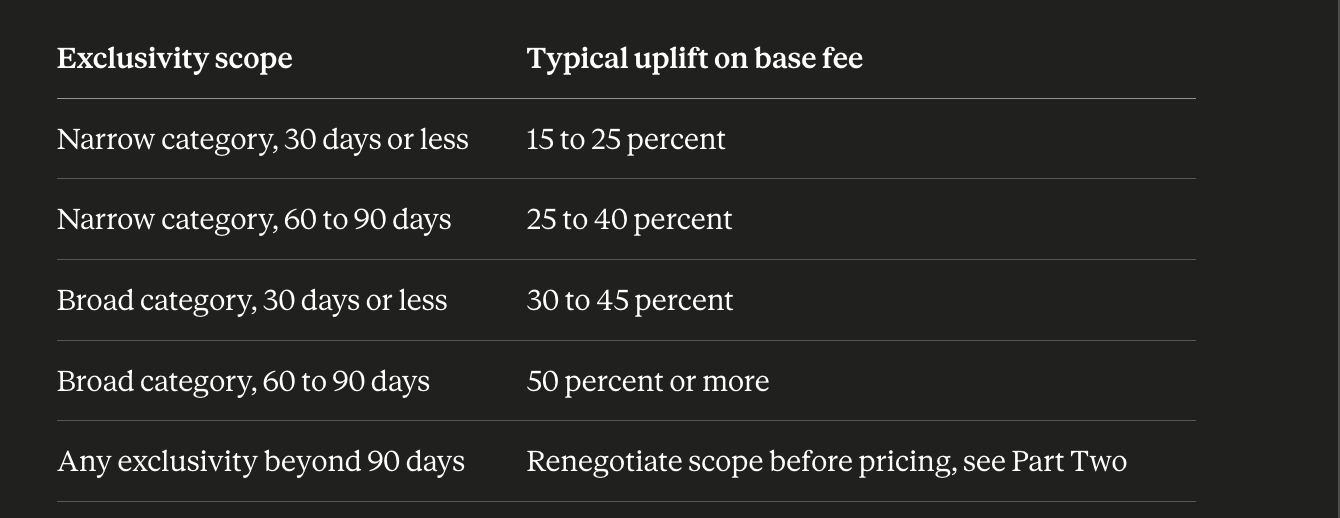
Treat this table as a starting point for a conversation, not a fixed price list. A creator with strong negotiating leverage, a highly engaged audience in a competitive niche, or multiple brands actively pursuing them, can reasonably push toward or beyond the top of each range.
Exclusivity is one of the most underpriced assets in the creator economy. Accepting overbroad category restrictions or accepting "bundled" exclusivity terms without an explicit fee line item quietly limits your earning potential and locks you out of lucrative brand deals for months. Whether you are an independent creator, talent manager, or agency representing a growing roster across the UK, EU, or US, every exclusivity restriction comes with a measurable opportunity cost that should be calculated, priced, and limited in scope.
At LegalLens, we specialize in drafting, reviewing, and negotiating commercial agreements built for the creator economy. We help influencers, talent managers, and agencies audit brand deal terms, establish defensible exclusivity pricing structures, and narrow overbroad category definitions—protecting your roster's income with flat-rate fee transparency and rapid turnaround times.
Pricing Duration Correctly
Duration should scale the fee close to linearly, not flatly. An exclusivity period of 90 days is not modestly more restrictive than 30 days, it is three times the restriction, and the fee should reflect that rather than being treated as roughly the same commitment with a slightly longer date range attached.
When to Refuse to Price It at All
If a brand will not separate exclusivity into its own line item and insists it is simply included in the base fee, that is a signal worth taking seriously. A brand unwilling to have this conversation transparently is often the same brand that will define the category too broadly, because they have not had to think about what the restriction is actually costing you.
Part Two: Narrowing Broad Category Traps
What a Category Trap Looks Like
The fee is only half the problem. The other half is how the category being restricted is actually defined, and this is where creators lose far more value than they realise, often without noticing until they turn down a deal months later and remember the clause.
A typical broad category trap reads something like: "The Influencer shall not promote, endorse, or work with any brand offering products or services that compete with the Brand, or that could reasonably be considered adjacent to the Brand's industry, for a period of 12 months."
This sentence has at least three separate problems, and each one needs to be renegotiated individually.
Problem One: "Compete" Is Undefined
The word "compete" with nothing else attached could mean a direct rival selling the same product, or it could be stretched by a brand later to mean anything loosely adjacent. Ask, explicitly, for the contract to name actual competitor brands, or at minimum a specific, narrow product category, rather than leaving "compete" open to interpretation after the fact.
What to ask for instead: "The Influencer shall not promote skincare brands offering vitamin C serums, specifically [Competitor A], [Competitor B], and [Competitor C], for the duration below."
This gives both sides certainty. You know exactly what you cannot do, and the brand cannot later claim an unrelated deal breached the clause.
Problem Two: "Adjacent" Is a Trap Word
"Adjacent to the Brand's industry" is one of the most common ways an exclusivity clause quietly expands far beyond what either side actually intended at signing. A skincare brand's "adjacent industry" could be read to cover haircare, wellness supplements, or even fashion, none of which the brand actually competes in, but all of which a broadly worded clause could be used to block.
What to ask for instead: Remove "adjacent" entirely, or if the brand insists on some buffer, replace it with a short, specific, named list of adjacent categories genuinely relevant to their business, agreed at the time of signing rather than left to later interpretation.
Problem Three: The Restriction Applies to the Wrong Thing
Broad clauses frequently restrict you from "working with" a competing brand at all, rather than restricting the specific type of content that would actually create a conflict. This can be read to block you from following a competitor, appearing at their event, or being tagged in someone else's post, none of which is a promotional endorsement.
What to ask for instead: Scope the restriction to paid or sponsored content specifically. "The Influencer shall not create paid or gifted sponsored content promoting [defined competitors] during the exclusivity period." This leaves organic, non-commercial interaction untouched.
The Category-Narrowing Checklist
Before signing any exclusivity clause, confirm each of the following is true. If any answer is no, it needs to go back to the brand before you sign.
Named competitors, or a specific product category, are listed rather than a general reference to "competing" or "adjacent" brands
The restriction applies to paid or sponsored content specifically, not to any interaction with a competitor
The duration is stated as a specific number of days or months, not left open-ended or tied to a vague trigger like "the life of the relationship"
The geographic scope is defined, a global exclusivity clause is a materially bigger restriction than one limited to your primary market, and should be priced and negotiated as such
The fee for exclusivity is itemised separately from your content fee, so both sides know exactly what is being paid for
A Negotiation Script You Can Actually Use
If a broad clause lands in your inbox, a direct, professional response works better than silence or an outright refusal. Something along these lines keeps the conversation moving rather than stalling it:
"Happy to agree to exclusivity for this campaign. Could we narrow the competing brands to a named list rather than the general category language, and confirm the restriction applies to paid content specifically? I'd also like to align on a separate fee for the exclusivity period, based on my typical rate in this category."
This does three things at once: it signals you are not refusing exclusivity outright, which keeps the deal moving, it puts the specific redline on the table clearly, and it opens the fee conversation without making it the first or only point raised.
Vague "competitor" language, open-ended timelines, and bundled, underpriced exclusivity terms quietly limit your earning potential long after a campaign ends. Whether you are an independent creator, a talent manager negotiating for a roster, or an agency executing multi-market deals, every exclusivity restriction comes with a measurable commercial cost. If a brand wants exclusive access to your audience, the terms should be narrow, explicit, and priced as its own distinct line item.
At LegalLens, we specialize in helping creators, talent managers, and digital agencies audit brand agreements, eliminate overbroad category traps, and negotiate fair exclusivity pricing. We review, redline, and restructure your brand partnership contracts with total flat-rate fee transparency and rapid turnaround times.
Frequently Asked Questions
Is it normal for brands to resist itemising exclusivity as a separate fee?
Yes, it is common, mostly because bundling it into the base fee avoids the brand having to justify the restriction on its own terms. Persistence here is usually worth it. A brand that values the partnership will engage with a reasonable, well-explained request.
What if I do not have enough deal history to use the opportunity cost method?
Use the percentage uplift table as your starting point instead, and revisit your pricing approach once you have more data. Even a rough estimate based on comparable creators in your niche is better than accepting an unpriced restriction.
Can a brand enforce an exclusivity clause that was never separately compensated?Potentially, if you signed it, but an exclusivity restriction with no specific consideration attached to it is more vulnerable to challenge than one clearly and separately paid for, particularly if the restriction is broad or long. This is exactly why pricing it properly at signing matters, not just for the money itself, but for the strength of the clause if it is ever disputed.
How do I know if a category definition is too broad?
A useful test: could you name, right now, at least one legitimate brand deal this clause would block that has nothing to do with the brand you are actually signing with? If you cannot immediately list the boundaries of what is restricted, the clause is not narrow enough yet.
Should exclusivity duration match the campaign length?
Not automatically, but it should be proportionate to it. A 90-day exclusivity period attached to a single Instagram post is disproportionate. A 90-day exclusivity period attached to a three-month ambassador role with ongoing content is far more reasonable, and should be priced accordingly.
How LegalLens Helps With Exclusivity Negotiations
LegalLens reviews and negotiates influencer contracts, including exclusivity terms, as part of our standard contract review service. We help you:
Calculate a defensible exclusivity fee based on your actual deal history and category
Redline broad category language into something specific, named, and fair to both sides
Push back professionally, with wording that keeps the deal moving rather than stalling it
Flat fee, capped at 10 percent of contract value, 24-hour turnaround.
Contact us at contact@legallens.co.uk to schedule a free 15-minute consultation.
The Bottom Line
Exclusivity clauses are not the enemy. Unpriced, undefined ones are. Treat the fee and the category definition as two separate negotiations, price the restriction against what it is actually costing you, and never accept "competing or adjacent brands" as a finished sentence. Ask the brand to finish it for you, in writing, before you sign.
This article does not constitute legal advice and is provided for general information purposes only. Regulations referenced are evolving and vary by jurisdiction. Always consult a qualified legal professional for advice tailored to your specific situation.