
The 2026 FTC Endorsement Guides – A Specialist Summary for Creators and Brands
In the United States, the Federal Trade Commission (FTC) is the primary regulator of commercial transparency. Under the FTC Act, any connection between an endorser and a brand that might affect the weight or credibility a consumer gives to an endorsement must be clearly disclosed.
At LegalLens, we help you navigate these standards to ensure your creative partnerships remain "honest and truthful" while protecting your business from deceptive advertising claims.
1. The Core Principle – Material Connections
A "material connection" is any relationship between a creator and a brand that a consumer wouldn't expect. If such a connection exists, it must be disclosed. This includes:
Financial Relationships – Direct payments, commissions, or affiliate links.
Incentives – Free products, "gifted" experiences, travel perks, or significant discounts.
Personal Ties – Family, employment, or ownership stakes in the brand.
The LegalLens Verdict – Do not assume your followers "already know" you work with a brand. Every individual post that functions as an endorsement requires its own disclosure.
2. The Standard of Disclosure – "Hard to Miss"
The FTC does not mandate specific wording, but it does mandate visibility. A disclosure is only legally sufficient if it is "clear and conspicuous."
Placement Guidelines
Above the Fold – The disclosure must appear before the "more" button or any scrolling is required.
Within the Content – For videos, the disclosure must be in the video itself (both audio and visual). For Stories, it must be superimposed over the image or video.
The Hashtag Cloud – A disclosure is legally ineffective if it is buried in a string of hashtags or links.
Terminology Standards
Approved Terms – Use simple, direct language like #Ad, #Sponsored, or #Advertisement.
Ambassador Status – Terms like [Brand] Partner or [Brand] Ambassador are acceptable if the brand name is clearly included.
Prohibited Shorthand – Avoid vague abbreviations such as #sp, #spon, or #collab. These do not meet the FTC’s standard for consumer clarity.
3. Format–Specific Requirements
As social media formats evolve, so do the FTC's expectations for transparency.
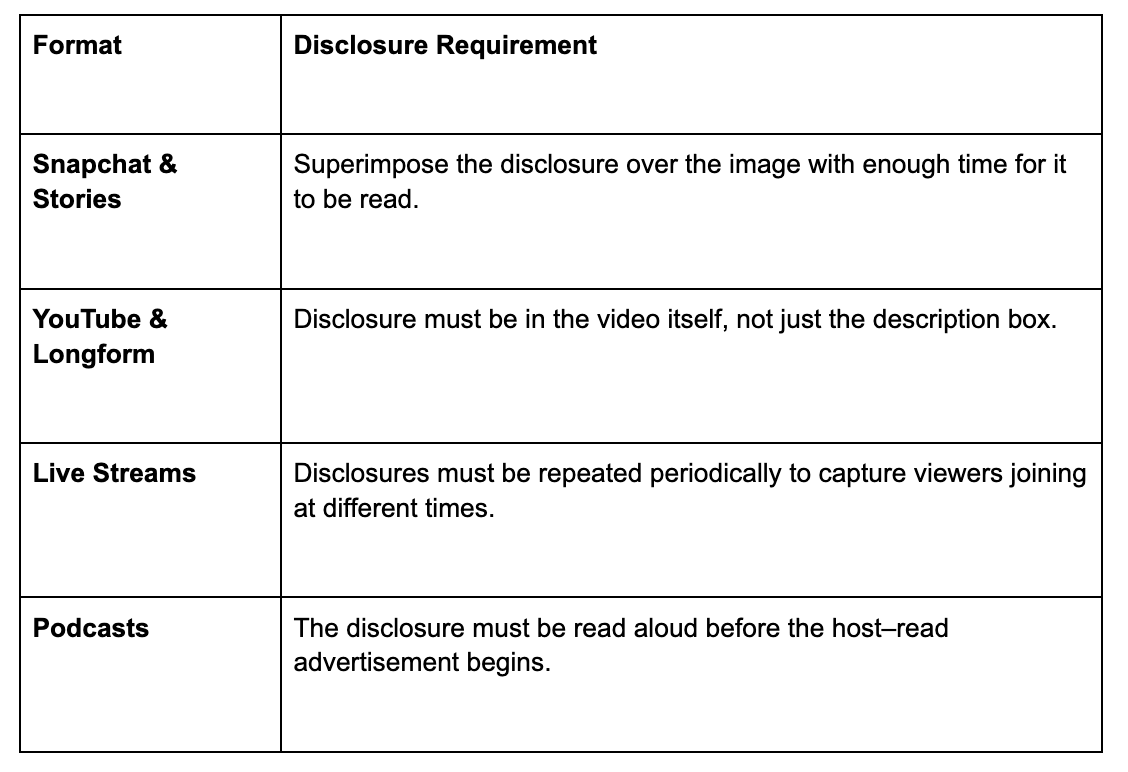
4. Obligations of Authenticity
Even with a perfect disclosure, an endorsement is deceptive if it is not genuine.
The Experience Rule – You cannot talk about your experience with a product you have not tried.
The Honesty Rule – You cannot say a product is "terrific" if you actually thought it was "terrible."
The Claims Rule – Creators cannot make specific claims that require scientific proof (e.g., medical or health benefits) unless the brand has provided verified substantiation.
5. Shared Liability – Who is at Risk?
The FTC holds all parties in the "marketing chain" responsible for compliance:
The Brand – Legally responsible for instructing and monitoring its influencers.
The Agency – Responsible for exercising "professional diligence" in campaign management.
The Influencer – Personally liable for deceptive claims or missing disclosures.
Secure your 2026 Strategy
The FTC’s primary focus is the "net impression" of the consumer. If an average user could be misled into thinking a post is organic, you are at risk. At LegalLens, we provide the contractual framework and audit protocols necessary to keep your business compliant.
Is your US strategy fully protected?
Disclaimer
The materials appearing on this website do not constitute legal advice and are provided for general information purposes only. No warranty, whether express or implied, is given in relation to such materials. LegalLens shall not be liable for any technical, editorial, typographical, or other errors or omissions within the information provided, nor shall we be responsible for the content of any web images or information linked to this website. Influencer marketing laws and ASA regulations in 2026 are complex; using this checklist does not create a lawyer–client relationship. We strongly recommend seeking professional legal counsel to ensure your specific agreements are fully compliant with current laws.