
2026 Influencer Disclosure Cheat Sheet (US Edition)
Stay Audit–Ready. Stay Compliant.
In 2026, the FTC’s standard for disclosure is "Unavoidable." If a consumer can view your content without seeing or hearing the disclosure, you are in breach. Use this guide to ensure every post meets the "Clear and Conspicuous" legal test.
1. The Golden Rules of Disclosure
The "First View" Rule – Disclosures must appear before the "More" or "See More" button.
The "Dual-Mode" Rule – If a video has audio, the disclosure must be both spoken and written on-screen.
The "No-Jargon" Rule – Use "Ad," "Paid Partnership," or "Sponsored." Avoid vague terms like "#collab," "#sp," or "Thanks [Brand]."
2. Platform-Specific Placement
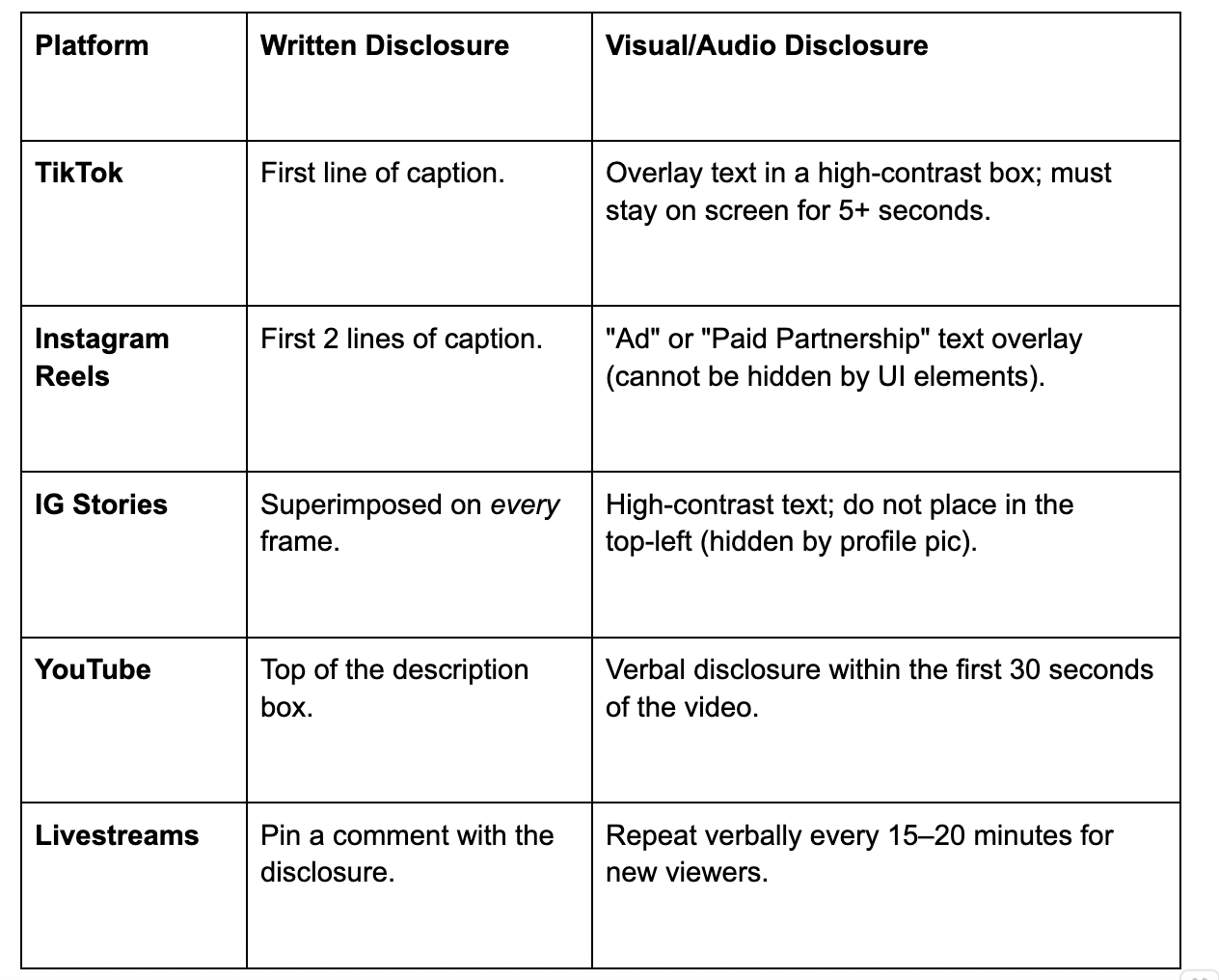
3. The 2026 "AI & Synthetic Media" Mandate
With the FTC's "Operation AI Comply" and New York's Synthetic Performer Law (June 2026), transparency is no longer optional for AI-assisted content.
Virtual Influencers/Avatars – You must conspicuously disclose if a persona is AI-generated (e.g., "Virtual Image" or "AI-Generated Performer").
AI-Enhanced Claims – If you use AI to "touch up" a product's performance (e.g., making hair look shinier or skin clearer), you must disclose this as "Digitally Altered" or "Retouched."
Deepfakes/Clones – Using an AI voice-clone or a digital body-double requires immediate, prominent disclosure to avoid "Deceptive Practice" penalties.
4. Is it a "Material Connection"?
If you answer YES to any of the following, you must disclose:
Did you receive cash or a flat fee?
Was the product "gifted" (even with no obligation to post)?
Do you use an affiliate link or a discount code?
Did the brand pay for your travel, hotel, or event ticket?
Do you have an ownership stake or employment tie to the brand?
LegalLens Verdict
The FTC can now seek civil penalties of up to $51,744 per violation. Relying on platform-native "Paid Partnership" tags alone is not enough. Always include your own manual disclosure to ensure you are fully protected.
Don’t leave your compliance to a hashtag.
At LegalLens, we specialise in protecting the businesses of the future. From auditing your 2026 TikTok USDS contracts to ensuring your "Masterbrand" strategy doesn’t trigger a junk food ad breach, we provide the clarity you need to scale safely.
Contract Analysis – We translate legalese into plain English so you know exactly what you are signing.
Compliance Audits – We ensure every post meets the latest FTC, ASA, and CMA standards.
IP Protection – We secure your content ownership and whitelisting rights for the long term.
Ready to future–proof your next campaign?
Frequently asked questions about the 2026 US disclosure rules
What does the FTC mean by an unavoidable disclosure in 2026?
An unavoidable disclosure means a consumer cannot miss the fact that a post is sponsored, regardless of how they consume the media. If a viewer can watch a TikTok, view an Instagram Reel, or scroll past a caption without explicitly seeing or hearing the disclosure, the post fails the FTC clear and conspicuous test.
Why is relying on platform-native paid partnership tags a legal risk?
Platform-native tags supplement a disclosure but do not replace your legal obligations. The FTC has repeatedly stated that automated system tags can be obscured by user interface elements or missed entirely by viewers. To be fully protected, you must always include your own manual text or verbal disclosure alongside platform tools.
What is the dual-mode rule for video content?
The dual-mode rule dictates that if an influencer marketing video features an audio track, the commercial disclosure must be delivered in two ways simultaneously. It must be spoken clearly during the audio and displayed as high-contrast overlay text on the screen.
How does the New York Synthetic Performer Law affect national campaigns?
Effective from June 2026, New York law requires a conspicuous disclosure whenever an advertisement features an AI-generated synthetic performer or a fabricated human likeness. Because digital campaigns on social media naturally reach New York residents unless those geographic areas are explicitly blocked, any brand or creator using AI-generated avatars or voice clones in the US must implement these disclosures immediately to avoid penalties.
Does a gifted product with no obligation to post still require a disclosure?
Yes, receiving a free item or a complimentary service constitutes a material connection. Even if a brand sends a gift with no formal agreement or expectation of a review, any subsequent content you post featuring that product must carry a clear advertisement label. The absence of a cash payment does not waive your disclosure duties.
Can an influencer be fined personally by the FTC for disclosure failures?
Yes, the FTC holds both brands and individual creators jointly liable for deceptive marketing practices. If an influencer fails to make a clear and conspicuous disclosure of a material connection, they can face individual enforcement actions and civil penalties alongside the brand partner.
DisclaimerThe information provided in this checklist is for general informational and educational purposes only and does not constitute legal advice. While this guide reflects current regulatory standards as of early 2026, the law in this area is subject to frequent change and differing interpretations. Using this checklist does not create a lawyer–client relationship between you and LegalLens. We strongly recommend that you seek professional legal advice tailored to your specific campaign, jurisdiction, and brand requirements before finalising your influencer agreements.