
Published by LegalLens | legallens.co.uk
Key facts: Copyright in a photo belongs to the person who took it, not the person in it. Reposting without a licence can infringe, even on your own account. In the US, registration and statutory damages can make a single post expensive.
Every few months a celebrity is sued for posting a photo of themselves on Instagram. It looks absurd, but it’s a clean illustration of how copyright works. This guide covers the basics first, then looks at what photographer Robert Barbera does and what creators and brands can learn from it.
Part 1: Copyright basics
What copyright protects
Copyright protects original creative works, including photographs, videos, music, writing and artwork. It protects the expression, meaning the specific image, not the idea behind it. Two people can photograph the same landmark. Each owns their own picture.
How you get it
Copyright arises automatically when an original work is created. In the UK there’s no registration system. In the US you don’t need to register to own copyright, but registration matters a lot for enforcement (more below).
Who owns it
The author, meaning the person who took the photo, is normally the first owner. There are two main exceptions:
Employment: work created by an employee in the course of their job usually belongs to the employer (called “work made for hire” in the US).
Transfer: ownership can be assigned to someone else, but this generally needs to be in writing and signed.
The person in the photo owns nothing in it by default. A famous face, or your own, doesn’t change this. Image and privacy rights are separate issues from copyright.
What the owner controls
The owner has exclusive rights to copy, share, publicly display, adapt and distribute the work. Posting a photo to Instagram involves copying and displaying it, which is why it needs permission.
Licences: how you legitimately use someone else’s photo
A licence is permission to use a work on agreed terms. Good licences specify:
the platforms (Instagram only? paid ads too?)
the territory and duration
commercial vs editorial use
whether you can edit or crop
credit requirements
the fee
Credit on its own isn’t a licence. Neither is tagging the photographer.
Unsure whether your content licences actually cover how a photo or video is being used?
Whether you are a creator licensing your work to brands or a company reposting third-party content across social channels, a missing licence clause can turn a simple post into an expensive copyright infringement claim. Book a free 15-minute consultation with LegalLens today to audit your usage rights, draft clear licensing agreements, and protect your intellectual property with flat fees.
Duration
In the UK and US, copyright in a photograph generally lasts for the author’s life plus 70 years (work-for-hire rules differ in the US).
Infringement
Using a protected work without permission, and without a valid exception, is infringement. Intent usually isn’t required. “I didn’t know” or “it’s a picture of me” may affect damages, but doesn’t make the use lawful.
Exceptions and defences
US: fair use. A flexible, fact-heavy test weighing purpose, nature of the work, amount used and market effect.
UK: fair dealing. Narrower, covering specific purposes such as criticism, review, quotation, news reporting and parody.
Other defences include a valid licence, the claimant not owning the work, or the claim being out of time.
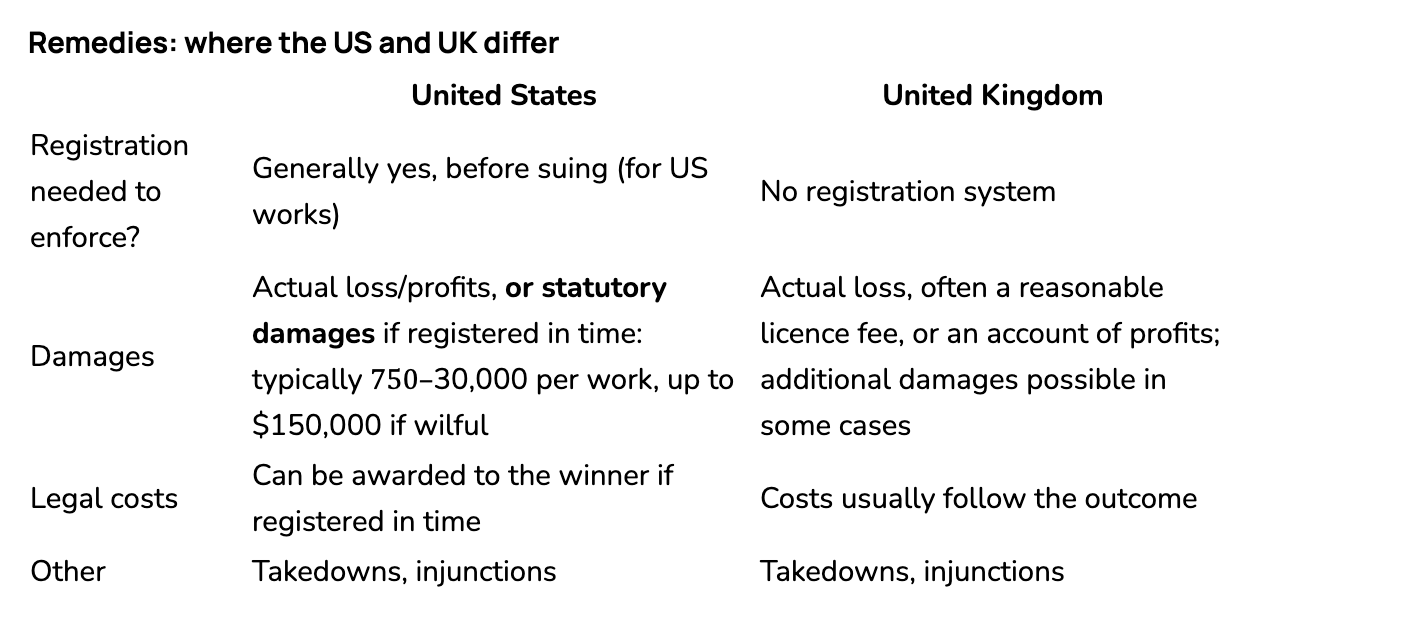
Statutory damages are why a single Instagram post can justify a lawsuit in the US. The claimant doesn’t have to prove what the use cost them.
Copyright management information
In the US, removing credits, watermarks or embedded copyright information can create a separate claim under the DMCA, on top of infringement.
Part 2: What Robert Barbera does
Barbera is a New York paparazzi photographer. Paparazzi photographers take pictures of public figures in public places and make money by licensing those images to media outlets and agencies. The reported cases against celebrities follow a recognisable sequence:
He takes the photo and owns the copyright. As the author, he’s the first owner.
He registers the photos. In the Ariana Grande case, the filing stated the photos were registered with the US Copyright Office and not licensed for her Instagram. Registration is what unlocks US statutory damages.
He finds the images in use. In the reported Dua Lipa case, he said he found the photos on her Instagram and tried to resolve it directly before the matter escalated.
He claims the larger of profit or statutory damages. In the Grande case, he sought either her profits from the post or $25,000 per photo.
The case is filed or settled. Outcomes vary widely.
The reported cases
Ariana Grande: filed in the Southern District of New York, later reported to have settled out of court, reportedly for $50,000. That figure comes from press reports, not a published court record.
Justin Bieber: a suit was filed against Bieber and the company controlling his brand.
Dua Lipa: one case over different photos was dismissed with prejudice, and a second suit followed.
Christian Siriano (Lady Gaga photo): the suit alleged the brand posted the image without a licence or authorisation.
Miley Cyrus: the suit concerned a photo of her leaving a building, posted to her 181-million-follower Instagram.
These are allegations and settlements, not findings of wrongdoing. Dismissals and settlements show that outcomes depend on the facts.
The wider debate
Barbera isn’t unique. Gigi Hadid, Jessica Simpson, 50 Cent and Khloe Kardashian have all faced similar claims. Supporters say photographers are entitled to be paid for their work and that celebrities profit commercially from the images they post. Critics say statutory damages encourage a volume-enforcement model that can seem disproportionate to a single post. The law, as it stands, favours the registered owner.
Worried that an unlicenced repost or missing credit could trigger a five-figure copyright claim?
As high-profile US lawsuits show, statutory damages and Digital Millennium Copyright Act (DMCA) rules mean a single social media post can carry steep financial exposure when image rights are not cleared in writing. Book a free 15-minute consultation with LegalLens today to audit your content licences, secure clear usage permissions, and protect your brand or creator account with flat fees.
Part 3: Practical lessons for influencers, agencies and brands
Never assume a photo of you is yours. Check who took it and what licence you have.
Get licences in writing, covering platform, territory, duration and commercial use.
Keep credits and watermarks intact.
Contract for image rights. Talent and brand agreements should say who supplies images and who clears them.
Hire photographers under clear agreements, with ownership or licence terms specified.
Act fast on a demand. Take the image down, keep records, and get advice before replying.
Check your exposure abroad. A UK creator with US followers or deals can face US claims.
In practice, copyright disputes rarely start with an intentional theft of creative work – they start with an informal assumption made during a fast-moving campaign. A brand reposts a creator's tagged photo onto its paid ad account without checking whether the original agreement covered paid amplification, or a creator shares a press image without realising the photographer retained commercial rights.
Because reverse-image tracking tools now scan social platforms continuously, rights holders can spot unlicensed uses within days. Treating image clearance and usage licensing as a standard part of your pre-posting workflow – rather than an afterthought – is the single most effective way to prevent five-figure settlement demands and protect cross-border partnerships.
Are your influencer agreements, brand reposts, and photographer contracts leaving your business exposed to copyright infringement claims?
In the creator economy, a single unlicenced social media post or poorly drafted usage clause can trigger five-figure settlement demands, statutory damages, or unexpected takedown notices across the UK, US, and EU. Whether you are an influencer licensing your content to sponsors, a talent agency managing campaign deliverables, or a brand clearing user-generated content and paid amplification rights, having clear, written copyright terms is essential.
At LegalLens, our specialist creator economy legal consultants review, draft, and negotiate tailored influencer agreements, photography licences, and image clearance clauses that define ownership, usage windows, paid media rights, and liability from day one. We provide practical, commercially focused contract support with flat fees and a 24-hour turnaround, giving you predictable legal protection without traditional law firm overheads.
Protect your content and campaigns before you publish – book your free 15-minute consultation with LegalLens at legallens.co.uk or email contact@legallens.co.uk.
Frequently Asked Questions
Who owns a photo of me?
The photographer, unless they’ve assigned or licensed it to you.
Is crediting the photographer enough?
No. Credit isn’t permission.
What if I delete the post?
Deleting limits ongoing harm but doesn’t wipe out a claim for the period it was live.
Does it matter that the photo is of me?
Not for copyright. Being the subject doesn’t give you ownership or a licence.
Can I be sued over a Story or a short-lived post?
Yes. Short duration may reduce damages but doesn’t remove the right.
What should I do if I get a copyright demand?
Don’t ignore it. Remove the content, preserve records, and speak to a lawyer.
Need help with image rights?
LegalLens offers flat-fee contract review for influencers, talent agencies and brands, including image-rights clauses.
The biggest legal risk for many influencer agencies is not a brand dispute or a bad post. It is a business model that was never checked against state licensing rules, wrapped in a management agreement that was never written to hold up when the relationship ends. Fix the structure first, write the commission and term clearly, and put compliance and payment obligations into the contracts before a creator or a regulator asks.
This article does not constitute legal advice and is provided for general information purposes only. Laws differ by jurisdiction and outcomes depend on the facts.