

Published by LegalLens | legallens.co.uk
Quick answer: In some US states, yes. California and New York license agencies that arrange work for artists, and in California the rule can catch managers and influencer agencies that "procure" brand deals without a license. An unlicensed agency risks having its management agreements voided and its commissions ordered back. Agencies should also set out commission terms clearly, define whether they act as agent or principal in brand deals, and build FTC disclosure and payment-flow obligations into their contracts.
Influencer talent agencies are growing fast, and many started the way creator businesses usually do: informally. A founder with good brand relationships begins pitching a few creators, takes a percentage, and scales from there.
What often gets missed along the way is that US law regulates parts of that activity. The risk does not sit in the brand contract or the creator's content. It sits in the agency's own business model, and it can surface years later, usually at the moment a creator wants to leave.
This guide covers the US legal issues influencer talent agencies most often overlook, and what to put in writing now.
Need a contract reviewed before you sign or send it? LegalLens reviews and drafts influencer agreements with fixed fees and a 24-hour turnaround.
Do Influencer Talent Agencies Need a License in the US?
It depends on the state and on what the agency actually does. The clearest example is California.
California's Talent Agencies Act (Labor Code section 1700 and following) requires anyone who procures, or attempts to procure, employment or engagements for an artist to hold a talent agency license from the Labor Commissioner. New York has its own licensing regime for employment agencies in the theatrical field, so an agency should not assume that being based elsewhere removes the issue.
The licensing question turns on conduct, not on the label. Calling yourself a manager, a consultancy, or a creator partnership company does not take you outside the rules if you are in practice finding and negotiating paid engagements.
What Counts as "Procuring Employment" for an Influencer?
In practice, procuring means finding, soliciting, or negotiating paid work for a creator. For an influencer agency, that covers a lot of ordinary activity:
Pitching a creator to brands for sponsored posts
Negotiating the fee, deliverables, or usage rights of a campaign
Responding to inbound brand enquiries and closing the deal
Booking appearances, endorsements, or ambassador roles
Courts and the California Labor Commissioner have applied the Act to personal managers, business managers, and others who engage in this kind of activity. California's authorities have also treated a manager as violating the Act even where no commission was charged for the engagement in question.
Social media creators have already brought disputes before the Labor Commissioner, and the question of whether a "social media influencer" falls within the Act's definition of an artist has been argued in those proceedings. Agencies should not assume that creator work sits outside the statute.
What Happens If an Agency Is Unlicensed?
This is where the exposure becomes a business risk rather than a technicality. Under the California framework:
The creator can petition the Labor Commissioner to declare the management agreement void
The agency can be ordered to return (disgorge) commissions taken for the unlawful procurement
The creator generally can recover commissions from within one year before filing, so the exposure is rolling rather than historic
The Labor Commissioner has original jurisdiction over these disputes, which means they are typically resolved there rather than in a standard court action
The California Supreme Court has confirmed the Labor Commissioner's broad authority in this area. In some cases, courts and the Commissioner have allowed parts of an arrangement to survive, but outcomes depend on the facts, and an agency should not build its business on the hope of leniency.
Practically, the risk tends to arrive when a high-earning creator wants out. An agency that has done years of work can find itself arguing about whether it was ever entitled to be paid.
Is your agency's representation agreement exposing your commissions to California Talent Agencies Act disputes?
Do not wait until a high-earning creator wants out to discover your management contract is unenforceable. Book a free 15-minute consultation with LegalLens today to audit your representation agreements, clarify your scope of services, and protect your agency's revenue with flat, transparent fees capped at 10 per cent of contract value.
Real-World Precedent: The Cost of Unlicensed Procurement
Case Brief: The Unlicensed Creator Agency
Context: A California-based digital management firm represented several social media creators under standard management agreements. The agency solicited brand deals, negotiated fees, and pitched the creators' audience analytics to third-party sponsors.
The Dispute: When relations broke down over delayed payments, the creators petitioned the California Labor Commissioner, alleging the agency acted as an unlicensed talent agency.
The Outcome: The Labor Commissioner confirmed that soliciting brand integrations and paid sponsorships for creators constitutes "procuring employment" under the Talent Agencies Act. The management agreements were declared void ab initio (legally non-existent from the start), stripping the agency of its contractual right to enforce commissions.
How Should an Agency Reduce Licensing Risk?
Treat licensing as a structural decision, not a paperwork exercise.
Map where your activity happens. Identify which states your agency, your creators, and your brand counterparties are in, since California and New York are the most common triggers.
Decide your model deliberately. An agency that procures engagements needs to evaluate licensing. A pure business-management or strategy role may be structured differently, but the line is fact-specific.
Do not rely on the label. "Manager" and "agency" do not decide the question. Activity does.
Take licensed advice. State licensing questions should be answered by a US attorney admitted in the relevant state, not by a template.
What Should a US Influencer Management Agreement Include?
Whatever the licensing answer, the management agreement should be clear enough that a creator, a brand, and a regulator would all read it the same way.
1. A clear scope of representation. State exactly what the agency does (brand deal sourcing, negotiation, campaign management, business strategy) and what it does not.
2. A transparent commission clause. Set out the percentage, whether it is calculated on gross or net, when it is deducted, and which income streams it covers. A vague commission clause is the first thing a dissatisfied creator will challenge.
3. A defined term and renewal mechanism. Avoid open-ended or silently auto-renewing terms. State the length, how renewal works, and how either side can end it.
4. Post-term commissions. If the agency will earn commission on deals it originated that close after the relationship ends, say how long that tail lasts and which deals qualify. This is a very common source of disputes.
5. Exclusivity. State whether the creator can work with other agencies, and for which categories of deal. Define it narrowly, and price it into the economics.
6. Termination rights. Include notice, cure periods, and what happens to live deals and unpaid fees.
7. Authority to sign. State whether the agency may sign brand contracts on the creator's behalf, or whether the creator must approve and sign each deal.
Is the Agency the Agent or the Principal in a Brand Deal?
This determines who is on the hook if something goes wrong, and it should be explicit in every brand contract.
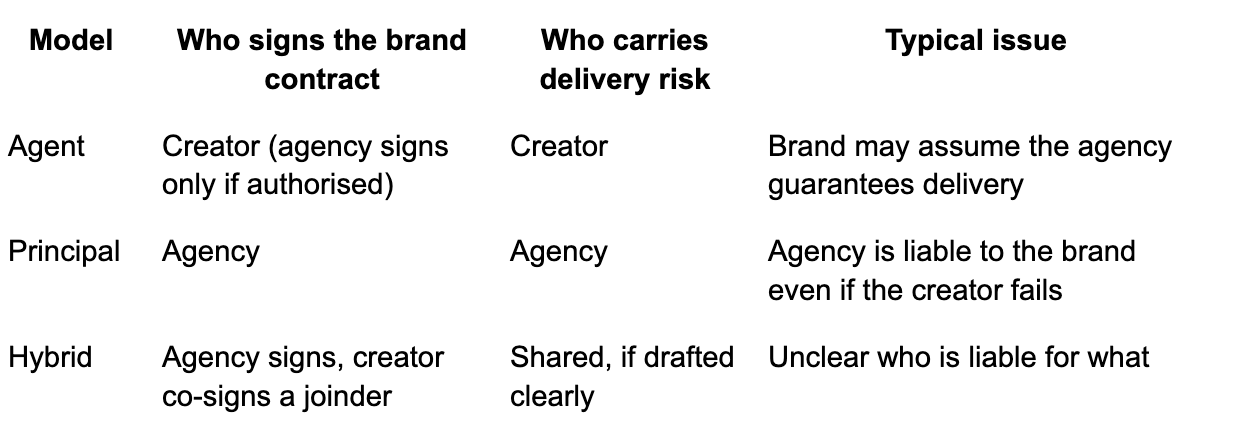
If an agency contracts as principal, it takes on the creator's performance risk. It needs a back-to-back agreement with the creator that passes the key obligations down: deliverables, disclosure, usage rights, and conduct. Without that, the agency is exposed to the brand while having no contractual hold over the creator.
What Are an Agency's FTC Responsibilities?
The FTC's Endorsement Guides apply to advertisers and to intermediaries such as advertising agencies and public relations firms, not only to the creator who posts. An influencer agency that coordinates campaigns, supplies talking points, or manages posting should assume it can be drawn in if a post is deceptive or lacks a clear disclosure.
The FTC can seek civil penalties of more than $50,000 per violation in appropriate cases, and it can also pursue consent orders that restrict future conduct. Agencies should:
Include a disclosure obligation in every creator agreement, with the required wording and placement
Review content before it goes live, and keep a record that they did
Train their roster, because platform tags alone do not replace a clear disclosure in the content
Avoid supplying claims about a product that the brand cannot substantiate
How Should Agencies Handle Payment Flows and Tax Reporting?
Where an agency collects the fee from the brand and pays the creator, the agency is handling client money, and the contract needs to say how.
Pay-when-paid. State whether the creator is paid on receipt of the brand's payment or on a fixed date, and make sure the brand contract and the creator contract are consistent.
Commission mechanics. Specify whether the agency deducts commission before remitting, and what the creator will see on a statement.
Statements and audit rights. Give creators a clear accounting and a reasonable right to review it. Transparency is the best defence against a later dispute.
Tax reporting. For payments made in 2026, the Form 1099-NEC threshold is $2,000 per payee per year. An agency that pays creators should consider its own information reporting obligations and take accounting advice, since the rules depend on how the money flows.
Checklist: Ten Questions Every US Influencer Agency Should Be Able to Answer
1 In which states do we, our creators, and our brand clients operate?
2 Do any of our activities amount to procuring engagements under California or New York law?
3 Have we taken advice from a state-admitted attorney on licensing?
4 Is our commission clause clear on rate, basis, timing, and scope?
5 Is the term defined, and does renewal require a positive step?
6 What do we earn after the relationship ends, and for how long?
7 Are we agent or principal in each brand deal, in writing?
8 Do our creator agreements pass through disclosure and usage obligations?
9 Do we review content before posting and keep a record?
10 Do creators receive clear statements and have a right to check them?
Are back-to-back creator contracts, FTC disclosure duties, and payment-flow mechanics leaving your agency exposed?
When your agency contracts as principal or manages creator payouts, a single missing clause can leave you liable to brands for campaign delays, regulatory penalties, or payment disputes. Book a free 15-minute consultation with LegalLens today to structure watertight creator agreements, build FTC compliance workflows, and protect your margins with flat fees capped at 10 per cent of contract value.
Frequently Asked Questions
Can a talent manager be forced to return commissions in California?
Yes. If a manager procured engagements without a talent agency license, the Labor Commissioner can order commissions to be returned, generally for the one-year period before the creator files a petition.
Does the Talent Agencies Act apply to social media influencers?
Influencers and their representatives have brought disputes under the Act, and the question of how it applies to social media work has been argued before the Labor Commissioner. Agencies should treat it as a live risk rather than assume it does not apply.
Does it matter if we do not charge a commission?
In California, the Act can apply even where no commission is charged for the specific engagement, because the prohibition is on the activity of procuring work without a license.
Is an influencer agency liable for a creator's FTC violation?
It can be. The Endorsement Guides cover intermediaries as well as advertisers and endorsers, so an agency that directs or approves content should have its own compliance process.
Should our agreement say we are the agent or the principal?
Yes, in plain words. It controls who signs, who is liable to the brand, and what you need from the creator in return.
How LegalLens Supports US Talent Agencies
LegalLens is a legal consultancy working exclusively in the creator economy. We are not a US law firm and cannot give state-licensed legal advice or court representation, so questions about licensing in California, New York, or elsewhere should go to a US attorney admitted in that state. What we do provide is practical contract and compliance support for agencies:
Reviewing and rebuilding management agreements, including commission, term, post-term, and exclusivity clauses
Structuring the agent or principal position in brand contracts, with back-to-back creator terms
Building FTC disclosure and content review requirements into your creator and brand agreements
Mapping your payment flows so statements, timing, and deductions are clear in writing
Our fees are flat, capped at 10 percent of contract value, with a 24-hour turnaround.
Contact us at contact@legallens.co.uk to schedule a free 15-minute consultation.
The biggest legal risk for many influencer agencies is not a brand dispute or a bad post. It is a business model that was never checked against state licensing rules, wrapped in a management agreement that was never written to hold up when the relationship ends. Fix the structure first, write the commission and term clearly, and put compliance and payment obligations into the contracts before a creator or a regulator asks.
This article does not constitute legal advice and is provided for general information purposes only. State licensing and regulatory requirements vary and change. Always consult a qualified attorney admitted in the relevant jurisdiction for advice tailored to your situation.