

Published by LegalLens | legallens.co.uk
Quick answer: A US influencer contract should name the right parties, scope the deliverables precisely, grant a clearly defined content licence (rather than a vague "work for hire"), require FTC-compliant disclosure, set exclusivity and payment terms in writing, and cover termination, indemnities and data. Since 2024 and 2025, several states and cities also require written contracts and fixed payment timelines for freelancers. A generic template usually misses at least some of this.
Need a contract reviewed before you sign or send it? LegalLens reviews and drafts influencer agreements with fixed fees and a 24-hour turnaround.
Why Do Influencers and Brands Need a Written Contract in the US?
A message thread can create a binding agreement, but it rarely answers the questions that cause disputes: who owns the content, where it can run, who checks the disclosure, and when payment is due.
Written contracts are also becoming a legal requirement in some places. Freelancer protection laws now operate in:
California (the Freelance Worker Protection Act, in force from January 1, 2025, for contracts of $250 or more)
Illinois (in force from July 1, 2024)
New York State (in force from August 28, 2024) and New York City
Los Angeles, Minneapolis, Seattle and Columbus
These laws generally cover solo independent contractors and require a written agreement with specific terms, plus payment by the contract date or within 30 days of completing the work if the contract is silent. Penalties can include double damages. Thresholds and details differ by place, so check the one that applies to you.
What Should a US Influencer Contract Include?
1. The parties and their roles. Use the legal names of the brand and the creator (or the creator's company), and state whether an agency is contracting as agent or principal. Make sure the entity that signs is the one that invoices and gets paid.
2. Scope of work and deliverables. State platform, format, number of posts, posting dates, how long content stays live, and the approval and revision process.
3. Content ownership and licence. Say who owns the content and exactly what the brand can do with it: channels, duration, territory, editing rights, and whether paid ads are included.
4. Whitelisting and paid amplification. Treat running ads through the creator's handle as a separate, priced permission with its own term and approval rights.
5. FTC and platform disclosure. Require clear disclosure and specify wording, placement and platform tools for each format.
6. Product claims. Provide approved claims and ban claims the brand cannot substantiate.
7. Exclusivity. Name the competitors or category, set a defined period, restrict only paid content, and price it.
8. Payment terms. State the fee, instalments, triggers, due dates, invoicing steps, and the consequences of late payment.
9. Kill fee and cancellation. Set out what is owed if the brand cancels after work starts, and what happens to the rights.
10. Morality and conduct clause. Define the conduct involved, require a link to real brand harm, and include a short cure period.
11. Warranties and indemnities. Cover compliance with law, originality of content, and who pays if a claim arises from a product or from a creator's breach.
12. Data and analytics. Say what performance data the creator will share, in what format, and how personal data is handled.
13. AI and likeness. Address whether AI tools can be used to make content, and prohibit using the creator's likeness or voice to train AI or create synthetic media unless separately agreed.
14. Termination and survival. State notice periods, breach and cure rights, content takedown obligations, and which clauses survive.
15. Governing law and disputes. Pick the state law and venue, and consider whether mediation should come first.
Influencer Contract Template: Clauses to Avoid
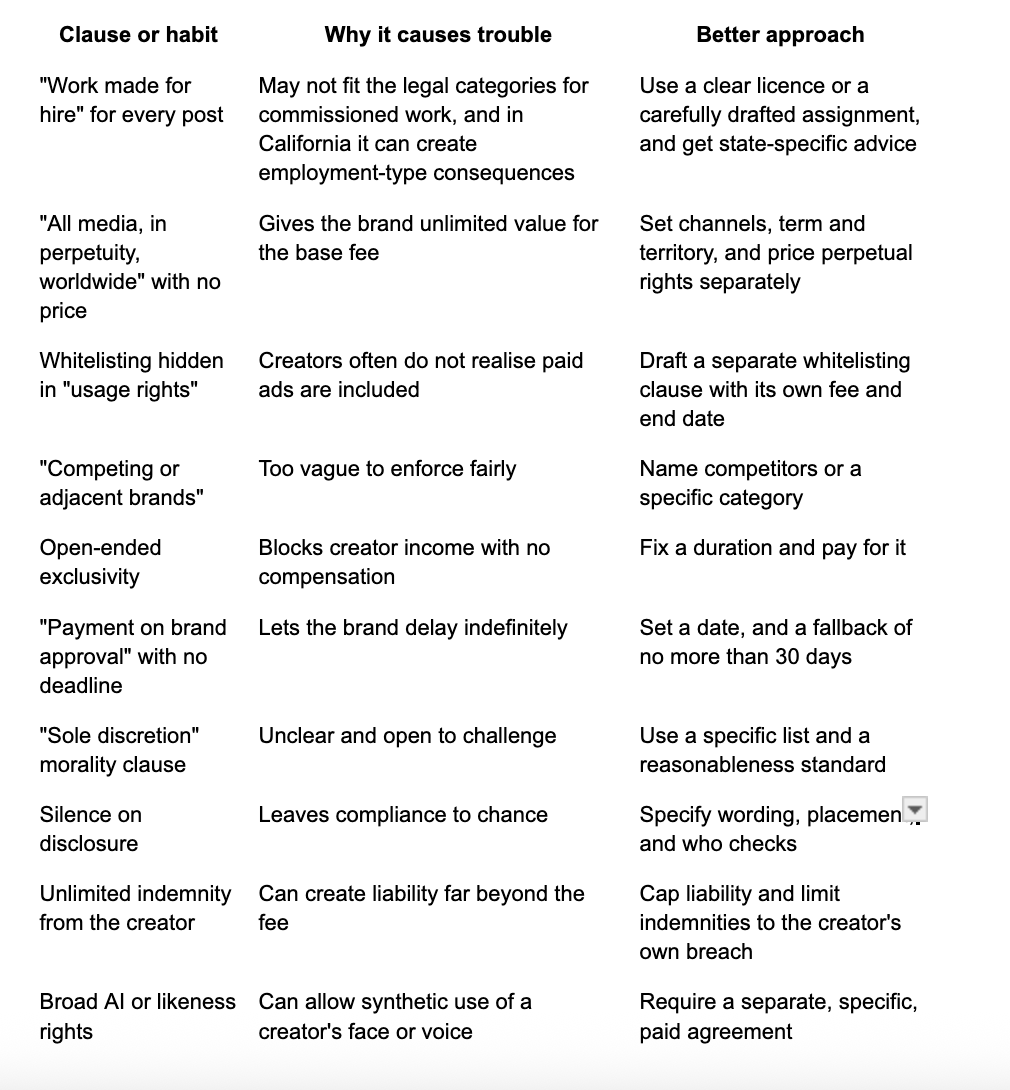
Spotted one of these in your draft? LegalLens can redline it and send back wording that keeps the deal moving.
What Do Most US Templates Get Wrong?
They are not written for your state. Freelancer laws, employment-classification rules and restrictions on post-term exclusivity vary. California in particular is cautious about restraints on trade after a contract ends.
They treat disclosure as a footnote. The FTC's Endorsement Guides place responsibility on brands as well as creators, so the contract should assign who checks and what happens if content is non-compliant.
They default to "work for hire". That wording is often inserted without thought for the legal categories or for state employment consequences.
They ignore affiliate and TikTok Shop deals. Commission-based arrangements need disclosure and claims rules too.
They omit the payment mechanics. Missing due dates, invoice steps and late payment terms are the main source of non-payment disputes.
They predate AI. Few cover synthetic content, digital replicas, or training use. Some states, including California and New York, have rules on contract terms about digital replicas, so vague wording is risky.
They forget tax paperwork. For payments made in 2026, brands generally need a W-9 from the creator and must consider Form 1099-NEC reporting at the $2,000 threshold.
Sample Clauses (Illustrative Only)
These examples show the level of detail to aim for. They are not a substitute for tailored drafting.
Licence and usage:
"Creator grants Brand a non-exclusive licence to use the Content on Brand's owned social channels and website for twelve (12) months from first posting, in the United States. Paid advertising and use through Creator's handle are not included and require a separate written agreement and fee. Rights under this clause take effect only on receipt of full payment."
Disclosure:
"Creator will clearly and conspicuously disclose the paid relationship in each post, using 'Ad' or '#ad' at the start of the caption and the platform's paid partnership tool, and, in video, by spoken and on-screen disclosure early in the content. Creator will not remove the disclosure while the post is live. Brand may request prompt edits or removal of non-compliant content."
Payment:
"Brand will pay the Fee in two instalments: fifty percent (50%) on signature and fifty percent (50%) within fourteen (14) days of the Content going live, following receipt of a valid invoice. In no event will payment be later than thirty (30) days after completion of the services."
How to Use an Influencer Contract Template Safely
Start with a template that matches your state and market. Treat anything generic as a draft.
Fill in the specifics. Replace placeholders with exact deliverables, dates, platforms, fees and rights.
Read the clauses you do not understand. Pay special attention to usage, exclusivity, indemnity and termination.
Check disclosure and claims language against current FTC guidance.
Confirm state requirements. If you are in or working with someone in California, Illinois, New York, Los Angeles, Minneapolis, Seattle or Columbus, check the freelancer law.
Get it reviewed when the stakes are high. Large fees, long exclusivity, perpetual rights or AI terms deserve a second look.
Sign and keep records. Store the signed version, the invoice and the approval trail.
Want a US-ready agreement without starting from scratch? LegalLens can draft or adapt an influencer agreement to your campaign, and review any template you already use.
Frequently Asked Questions
Is a free influencer contract template enough?
It can be a useful starting point, but free templates are generic. They often miss state freelancer rules, FTC disclosure duties, whitelisting, exclusivity pricing and AI terms. Review it against your actual deal before you sign.
Do I need a written influencer contract in the US?
Not always, but increasingly yes. California, Illinois, New York and several cities require written agreements for many freelance engagements, and a written contract is the best way to prove what was agreed in any case.
What is the difference between a licence and "work for hire"?
A licence lets the brand use the content on agreed terms while the creator keeps ownership. "Work for hire" treats the brand as the author, but it only fits certain categories of commissioned work, and in some states, such as California, it can have employment consequences. Many influencer deals work better with a clear licence.
What should an influencer contract say about disclosure?
It should require clear and conspicuous disclosure, specify wording and placement for each platform, say who reviews content before it goes live, and give the brand a right to require prompt fixes.
How long should exclusivity last?
As short as the business purpose allows and proportionate to the campaign. It should name the competitors or category and be priced separately.
How soon must a brand pay an influencer?
Whatever the contract says. Under freelancer laws in places such as California, Illinois and New York, the default is payment within 30 days of completing the work if the contract is silent. Always put a specific date in writing.
Can a contract cover AI-generated content and my likeness?
Yes, and it should. Say whether AI tools may be used, and prohibit using the creator's face or voice to train AI or create synthetic media without a separate, specific agreement.
Does a brand need to send a 1099 to an influencer?
For payments made in 2026, brands generally need to issue a Form 1099-NEC if they paid a creator $2,000 or more in the year. Creators should still report all income, whether or not a form arrives.
How LegalLens Helps With US Influencer Contracts
LegalLens is a legal consultancy working exclusively in the creator economy, with brands, influencers and talent agencies. We are not a US law firm and cannot give state-licensed legal advice or court representation, so questions that turn on a specific state's law should go to an attorney admitted there. What we do offer is practical contract support:
Drafting influencer agreements tailored to your platform, campaign and market
Reviewing templates and counterparty drafts and flagging clauses to renegotiate
Building master agreements for brands and agencies running many creator partnerships
Compliance support on FTC disclosure and creator payment terms
Our fees are flat, capped at 10 percent of contract value, with a 24-hour turnaround. Contact us at contact@legallens.co.uk to schedule a free 15-minute consultation, or browse our free checklists on legallens.co.uk.
The Bottom Line
A template is a starting point, not a safeguard. The contracts that hold up are specific about deliverables, honest about who owns what, clear on disclosure and payment, and written with the relevant state rules in mind. Take the time to fill in the blanks properly, avoid the clauses above, and have anything high-value reviewed before it is signed.
Ready to put your next deal on solid ground?
This article does not constitute legal advice and is provided for general information purposes only. Laws vary by state and change over time, and the sample clauses are illustrative only. LegalLens is a non-regulated legal consultancy and does not provide the services of a US attorney. Always consult a qualified attorney admitted in the relevant jurisdiction for advice tailored to your situation.