

Published by LegalLens | legallens.co.uk
Perpetual rights are rights that never expire. In a contract, they let one party use something, such as a photo, video or post, for as long as they like, with no end date and no need to renew or pay again. The creator usually still owns the work. The other party just never has to stop using it.
That is the short answer. The detail is where the money and the risk sit, so here is how it works in practice.
Need a contract reviewed before you sign or send it? LegalLens reviews and drafts influencer agreements with fixed fees and a 24-hour turnaround.
What does "perpetual" mean in a contract?
"Perpetual" means the right has no expiry date. You will also see it written as "in perpetuity", "for all time" or "without limit of time". They all mean the same thing: the permission carries on indefinitely.
Perpetual usually travels with other words. Each one widens the deal:
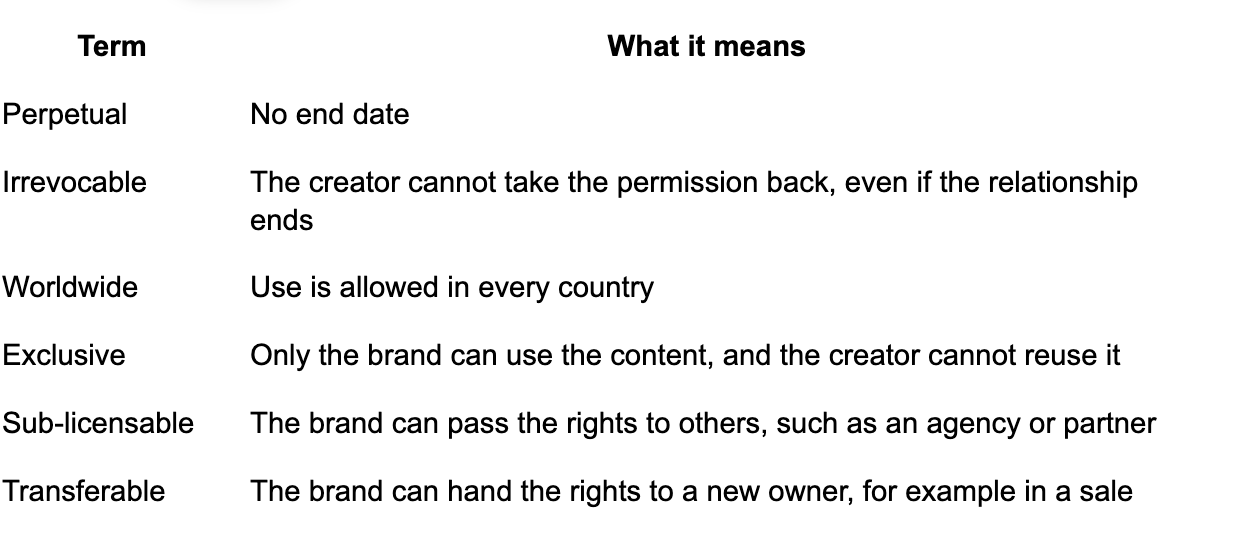
A clause that says "perpetual, irrevocable, worldwide, exclusive licence" is very different from one that says "perpetual licence". Read every adjective.
What are perpetual usage rights?
Perpetual usage rights are the right to use a piece of content for ever. In influencer marketing, this usually means a brand can keep using a creator's photos, videos or posts in its marketing without a time limit.
The brand might use the content on its website, in emails, on its social channels, in paid ads, in pitch decks, on packaging or in-store. Which of those uses are included depends on the wording. A good contract lists them. A weak one says "all media".
Perpetual licence vs ownership: what is the difference?
This is the point most people miss.
A licence is permission to use something. Ownership, known as an assignment, transfers the copyright itself. Under UK law, the person who creates content usually owns the copyright by default. A perpetual licence leaves that ownership with the creator. An assignment moves it to the brand.
In practice:
With a perpetual licence, the creator still owns the content but cannot stop the brand using it within the licence terms.
With an assignment, the brand owns the content outright. The creator may need the brand's permission to reuse their own work.
An assignment has to be in writing and signed to be valid in the UK. If a contract says the brand "owns all rights", you are looking at an assignment, even if the word never appears.
Navigating intellectual property in the creator economy requires understanding how UK copyright law intersects with commercial agreements. Because content creators automatically hold the copyright to the photos, videos, and reels they produce, signing away long-term access without professional guidance can accidentally strip away future monetization opportunities. Whether an agreement calls for a limited-duration commercial license or a permanent buyout, influencer contract negotiations should explicitly separate ownership from usage rights so that neither creators nor brands face unexpected legal ambiguities down the line.
Why do brands ask for perpetual rights?
Three reasons come up again and again:
Cost. Paying once is cheaper than renewing usage every few months.
Convenience. Nobody needs to track expiry dates across dozens of creators.
Archive. Brands do not want to delete old posts from their own feeds or websites.
The third reason is often the easiest one to solve without handing over perpetual rights. More on that below.
Are your perpetual usage clauses giving away years of content value for free?
Whether you are a creator protecting your intellectual property or a brand structuring commercial licences, vague usage terms can cost thousands in lost licensing fees or legal exposure. Book a consultation with LegalLens today to audit your usage rights, structure clear archival terms, and protect your content value with capped, transparent legal fees.
What are the risks of perpetual rights?
For creators:
The brand can use your face, voice and words long after the campaign, and after your views or career have changed.
You are paid once for use that has no limit.
An exclusive grant can stop you reusing your own content in your portfolio or for other brands.
You may be tied to a brand you later want nothing to do with.
For brands:
Old content can become misleading. If a creator endorsed a product years ago and no longer uses it, reusing that endorsement can breach advertising rules, which require endorsements to be genuine.
Reusing a creator's post as a paid ad turns it into the brand's advert. It needs to be properly labelled as an ad.
If the creator's reputation changes, the brand may be stuck with content it does not want to run but cannot easily distance itself from.
Poorly drafted perpetual clauses are a common source of disputes over what was actually agreed.
What is a better alternative to perpetual rights?
Most brands do not need perpetual rights. They need three things, and each can be covered separately:
Active use for a fixed period. For example, 6 or 12 months of paid and promotional use.
Archival retention. The brand can leave the original post on its own feed or website, without promoting or boosting it.
Renewal option. The brand can extend active use for an agreed fee.
This gives the brand what it actually needs and gives the creator a fair price for ongoing commercial use.
How to spot a risky perpetual rights clause
Check for these in any contract you are asked to sign:
"All media, now known or later invented"
No fee attached to the extra rights
No limit on paid advertising use
Rights that survive termination, even if the brand breaches the contract
A waiver of moral rights, which includes the right to be credited as the creator
If you see more than two of these together, stop and negotiate before you sign.
Beyond individual disputes, failing to properly scope usage windows creates severe regulatory exposure under evolving advertising standards. Both the UK Advertising Standards Authority (ASA) and the Competition and Markets Authority (CMA) scrutinize how older content is recycled across digital channels, particularly if an influencer's public endorsement no longer reflects their genuine, current opinion. When influencer marketing agreements rely on outdated or overly broad perpetual clauses, brands risk substantial compliance penalties, while creators lose control over their personal brand identity and digital likeness.
Are risky perpetual clauses and vague usage terms putting your brand or creator career at risk?
Do not let poorly drafted licences sign away long-term content value or expose your campaigns to regulatory scrutiny. Book a consultation with LegalLens today to audit your contracts, negotiate balanced usage windows, and secure your intellectual property with transparent, capped legal fees.
Frequently asked questions
What does perpetual rights mean?
Perpetual rights are rights with no expiry date. The holder can use the work for as long as they want without renewing or paying again.
What is the difference between perpetual and irrevocable?
Perpetual means the right has no end date. Irrevocable means the creator cannot cancel it. A right can be perpetual but still end if the contract is terminated for breach. Irrevocable and perpetual together make it very hard to bring the right to an end.
Does in perpetuity mean forever?
Yes. In perpetuity means for all time, with no end date.
Do perpetual usage rights mean the brand owns my content?
No. A perpetual licence lets the brand use your content but you remain the owner. An assignment is what transfers ownership, and it has to be in writing.
Can a perpetual licence be cancelled?
Only if the contract allows it. If the licence is irrevocable, you generally cannot cancel it. Check termination and breach clauses before signing.
Are perpetual rights normal in influencer contracts?
They are common in brand templates, but they are not a given. Many creators negotiate a time-limited licence instead, or charge a premium for perpetual use.
Is it legal to ask for perpetual rights in the UK?
Yes. The question is whether the terms are fair and the price reflects what you are giving up.
This article does not constitute legal advice and is provided for general information purposes only. Always consult a qualified legal professional for advice tailored to your specific situation.